Work in Progress
-
Investments in Human Capital in the Age of Artificial Intelligence
Abstract
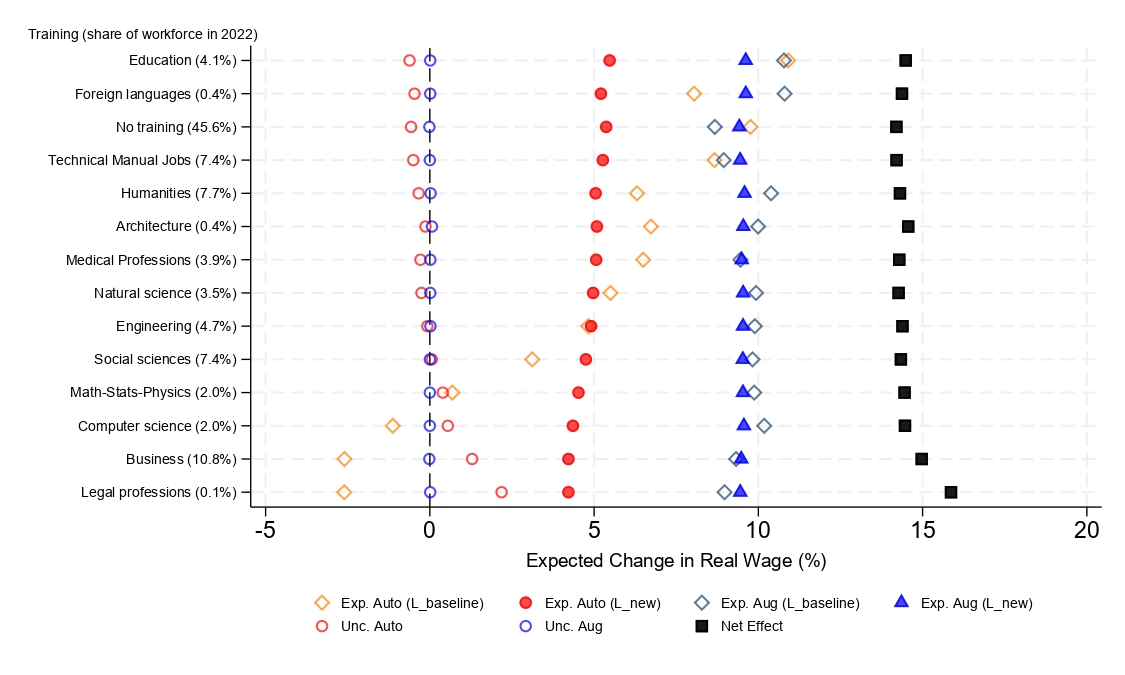
How does Artificial Intelligence reshape human capital investment decisions? I develop a task-based model where risk-averse agents make irreversible training choices based on AI's expected impact and uncertainty. Calibrated to the US labor market, the framework decomposes AI shocks into expected automation, expected augmentation, and their associated uncertainties. The model yields three key results. First, expected automation drives a structural reallocation, causing young students to systematically avoid training paths facing high automation risk, while choosing paths requiring more manual or social skills. Second, average expected wages rise, but their distribution depends on the responsiveness of training choices made by the new generation: when it is high, labor scarcity offsets the direct impact of AI and wage gains are nearly uniform across training paths; when it is low, labor reallocation is weaker, and wage gains are more concentrated in the safest paths. Third, automation uncertainty generates an endogenous risk premium.
-
Overeducation Persistence Over the Lifecycle: Disentangling Frictions, Specialization and Aging
Abstract
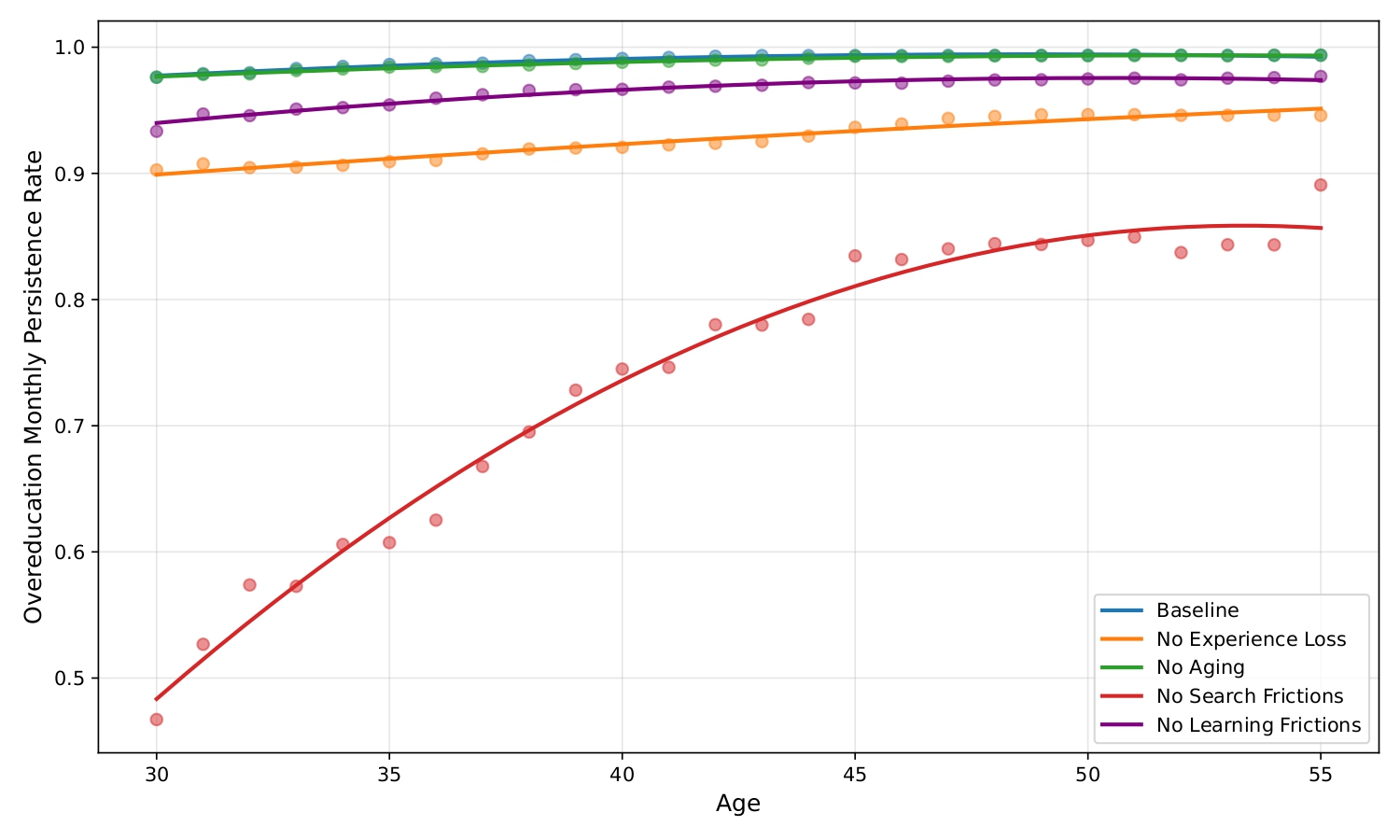
I study overeducation persistence with a directed-search model in which workers differ in education, field of study, field-specific experience, and age. Calibrated to the NLSY79 and O*NET, four counterfactual scenarios decompose persistence into its structural channels. Search frictions are by far the dominant driver: removing them would reduce monthly persistence from 97% to 50% early in the career. The specialization trap---non-transferable field-specific experience---is the second most important channel, and learning frictions contribute to a smaller extent. Age effects are negligible. Education is treated as exogenous to focus on post-schooling dynamics. Policies that reduce matching frictions, particularly early in the career, are most effective.